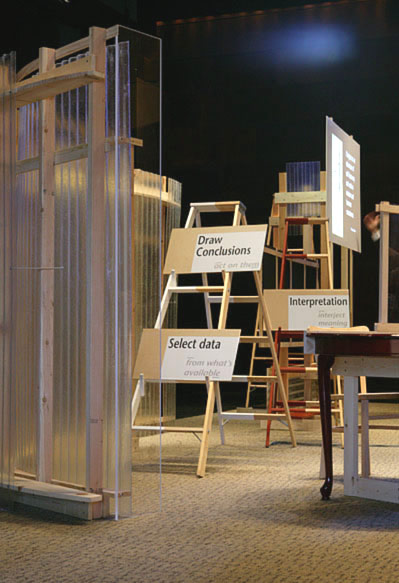
This project brought the opportunity to work with faculty at the University of Minnesota on a project to construct a representation of the intellectual effort they undertook to re-vision how they understood the task of developing leadership for the University. Originally, I was invited to attend semi-annual meetings of the group and construct an 'image wall' chronicling their activities as a means to document the work of the faculty. Meetings typically were attended by 40-65 faculty, staff and community members.
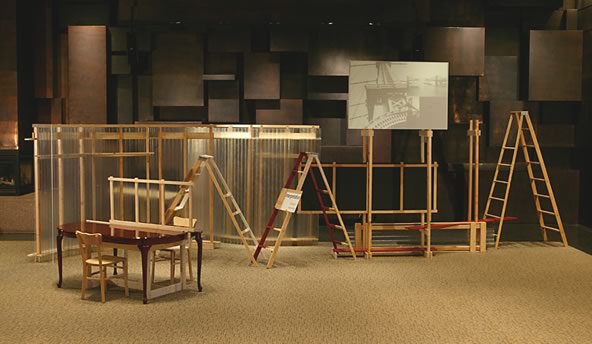
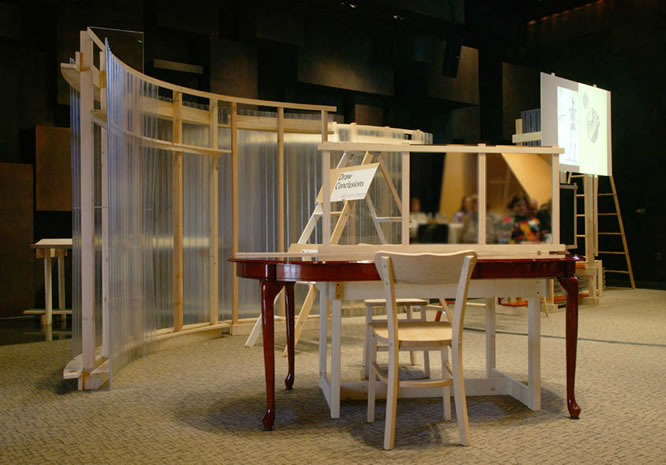
It quickly became evident that there were far more fruitful ways to integrate the arts component into a dialogue with the evolving discussions of the group. The images on this page provide samples of the 'stage' that emerged as we collaborated on building the leadership model. As a participant in the process, I facilitated the articulation of metaphors the group began to work with as they developed their language. For example, the image of bridging to reconcile differences or to build necessary alliances was frequently employed. It was also clear that the process of bridging was needed between entities that were constructions of inferential ladders. Simply put, as individuals or organizations we bring the sum of our unique, yet narrow, experiences to our relations with others. So, real ladders were set in bridging relationships allowing the group to unfold the concepts they were using - making them concrete by actually placing them in relationship to one another.
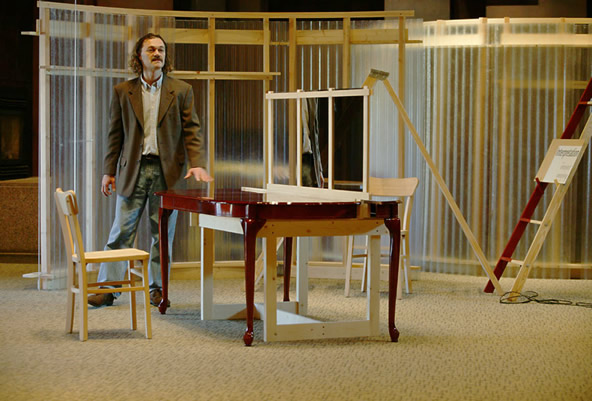
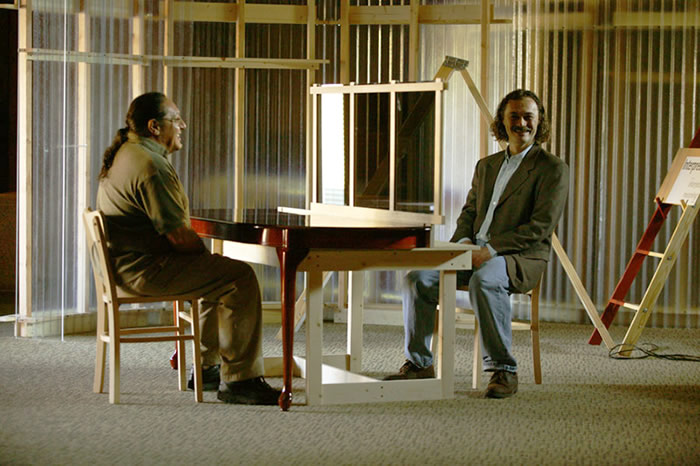
This exercise was repeated over the course of the meetings as other metaphors arose within the group, and a structure began to materialize that reflected their work. Along with building the construction, I would spend time during each session presenting newly constructed elements and adjusting the work based on their response to the structure. The presentations were accompanied with images projected onto a screen integrated into the sculpture. We would review the meanings in the work and suggest ways in which it needed to be altered to better capture the developing vision. The sculpture remained central to (traveled to) all sessions of the group and stood throughout the two-day sessions as a means for participants to refer to and evaluate their process.
Between sessions I would meet with a core oversight group and we would discuss ideas for elements that needed to be incorporated into the sculpture for the next meeting.
The inherent ambiguity of the artwork allowed for many potentially divisive issue to be re-framed and approached through the sculpture rather than the particulars of specific circumstances (for exapmple, the issue of power-who has it and how is it used-could easily have provoked members of the group from different, competing constituencies to become defensive)-follow this link for more information. This was extremely important for the participants as they began to trust in the way that shared meanings can be created through ambiguity.
The piece served not only to report on the process, but to provide an important evaluative tool for the group from session to session.